
On 10 December, ADI held its 2nd End of Year forecast event, focusing on the important topic of diagnosis under the theme of ‘The Diagnostics Revolution; Are We Ready’. The event hosted in collaboration with Edelman and opened by Carolyn Paul, EMEA Chair of Health for Edelman, featured ADI CEO Paola Barbrino in conversation with Dr Alireza Atri, an internationally renowned cognitive neurologist, clinical researcher, and educator. With over 1,300 online registrations, and a full-house in London, the event marked the end to an important year.
In addition to the recording, for the first time, a full transcript of the End of Year Forecast will be made available in January. This verbatim transcript, will be an additional resource to reflect or better understand the content that Paola and Dr Atri discussed during this event.
Discussion overview
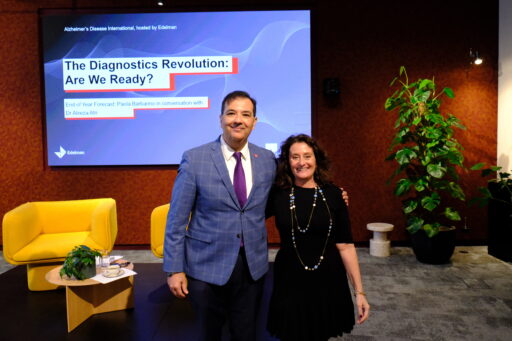 Dr Atri and Paola Barbarino started their discussion by providing an overview of the current diagnostic landscape, highlighting the advances in the treatment landscape since the discovery of the condition in 1910, and how our understanding of Alzheimer’s disease and other dementias, such as Lewy bodies, prion diseases, frontotemporal dementias among others, have been shaped through progressive research advances. Importantly Dr Atri reiterated the need for persons living with dementia to be at the centre of treatment and diagnostic considerations.
Turning to diagnostics, Dr Atri highlighted recent advancements in blood based biomarkers, noting that blood biomarkers have been approved in the US and Japan, and dozens more waiting to be evaluated, and emphasised the need for greater specificity in dementia diagnosis, drawing a parallel with the field of cancer, where treatments are increasingly tailored to the presence or absence of specific markers and prescribed as second- or third-line therapies.
Dr Atri concluded that blood-based biomarkers may help drive these advances, particularly in identifying asymptomatic individuals with Alzheimer’s disease who have amyloid pathology but maintain sufficient cognitive reserve to offset symptoms.
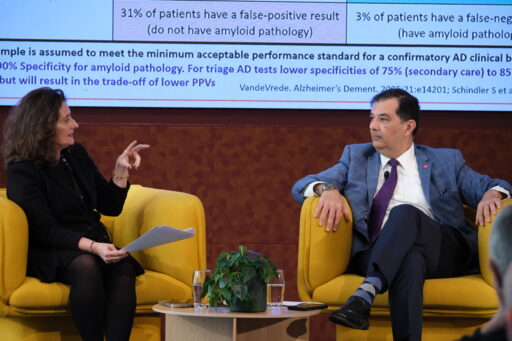
However, Dr Atri cautioned that these results must be interpreted holistically, carefully and in context. Drawing on evidence from VandeVrede et al. and Schindler. S et al., he noted that in individuals under 60 years old, a positive blood-based biomarker test for Alzheimer’s disease is only likely to represent a true positive in around 20% of cases. In contrast, among patients aged 75, the likelihood of a true positive rises significantly to approximately 85%.
Paola and Dr Atri exchanged questions in a thought-provoking discussion around diagnostics before moving on questions from the audience.
One participant expressed concern that wider use of biomarker-based diagnoses could leave more people waiting for confirmatory testing, underscoring the limited preparedness and capacity of health and care systems. Dr Atri acknowledged these concerns, emphasising the need to expand and retain the healthcare workforce, which would require targeted investment. He also reiterated the importance of specificity when introducing new biomarker modalities, noting that more contextualised testing can help reduce false positives.
Attendees also inquired as to the role that Artificial Intelligence (AI) will play in the future for the diagnosis process. Dr Atri highlighted that AI could help with the analysis of diagnostic images for Alzheimer’s disease, particularly where shifts or changes are more difficult to spot, as well as assisting with medical records and medical administration. However, Dr Atri suggested caution and tempering of excitement surrounding its use.
An online participant emphasised the urgency of advancing dementia diagnostics and called for a movement to ensure that health and care systems are prepared for upcoming research developments. In agreement, Dr Atri suggested that addressing this challenge requires collaboration among academics, clinicians, and policymakers. He acknowledged that health and care systems are currently unprepared, but stressed that they have no choice but to become ready at all levels.
To illustrate this point Dr Atri said:
When you visit a doctor and say I have a pain in the left side of my chest, no doctor says,“everyone gets that sometimes”, this is not the same when concerned individuals discuss memory problems.
A key takeaway from the event was the acknowledgment that this discussion is no longer about being prepared for the future but that is diagnosis revolution is happening right now. To this end, and with so many more questions being submitted, ADI will host a follow-on webinar 26 February 2026, which will give us chance to explore how these new diagnostics are being introduced into clinics, the education and training needed, the impact of the diagnostic pathway and importantly the impact on post diagnosis support.
Register for ADI’s upcoming webinar: The diagnostics revolution is now
ADI would like to thank our sponsors Eisai, Roche, GE Healthcare, Acadia, Johnson & Johnson and Re:Cognition Health, for supporting this End of Year Forecast event and thank everyone who joined us online and in-person to discuss the diagnostic revolution.
For those who were unable to attend, the event recording is now available on YouTube.
