

Across much of the Asia–Pacific, dementia care happens quietly – and often invisibly
Behind closed doors in low- and middle-income countries, families shoulder almost all responsibility for caring for a loved one living with dementia. Formal aged care services are limited. Trained professionals are scarce. Guidance is hard to find. And the weight of care falls overwhelmingly on family members – often women – who are doing one of the most complex and emotionally demanding jobs imaginable, with little structured support.
“They are doing one of the hardest jobs there is, with the least support,” says Professor Tuan Anh Nguyen from the National Ageing Research Institute (NARI), Swinburne University of Technology and the Global Brain Health Institute, who has spent the past decade strengthening dementia care systems across the region, with a focus on equity and access.
In countries such as Vietnam and Indonesia, families provide nearly all care for people living with dementia. Many carers manage behavioural changes, medical needs and daily care at home without professional advice, while coping with stress, anxiety, social isolation and financial pressure. Opportunities for practical training – how to respond to agitation, how to communicate effectively, how to navigate health and social services – are limited.
Cultural and language barriers deepen the gap. Most carer support programmes are developed in Western contexts and do not reflect local languages, beliefs, or family structures. As Professor Nguyen explains, “Families need support that speaks their language and reflects their culture.”
What is e-DiVA?
To respond to this need, NARI partnered with Atma Jaya Catholic University of Indonesia, the University of Auckland, and the Vietnam National Geriatric Hospital to develop e-DiVA – empowering Dementia Carers with an iSupport Virtual Assistant.
e-DiVA builds on the World Health Organization’s iSupport programme, an internationally recognised educational resource for dementia carers. But this was not a simple translation exercise. The team worked closely with carers and local stakeholders across the Asia–Pacific to culturally and linguistically adapt the content, ensuring it is relevant, practical and easy to use in real-world caring contexts.
The result is a flexible digital platform combining evidence-based information with multimedia and interactive features. Available in English, Bahasa Indonesia and Vietnamese, e-DiVA has been designed for use across low- and middle-income countries, as well as culturally and linguistically diverse communities in Australia and New Zealand.
Key features include:
- Short videos and an online course to build caring skills and confidence
- Simple, practical guidance for everyday situations
- Voice search to help carers find information quickly
- Personalised content based on individual care needs
- Opportunities for peer connection and shared experience
- A directory of locally available dementia services
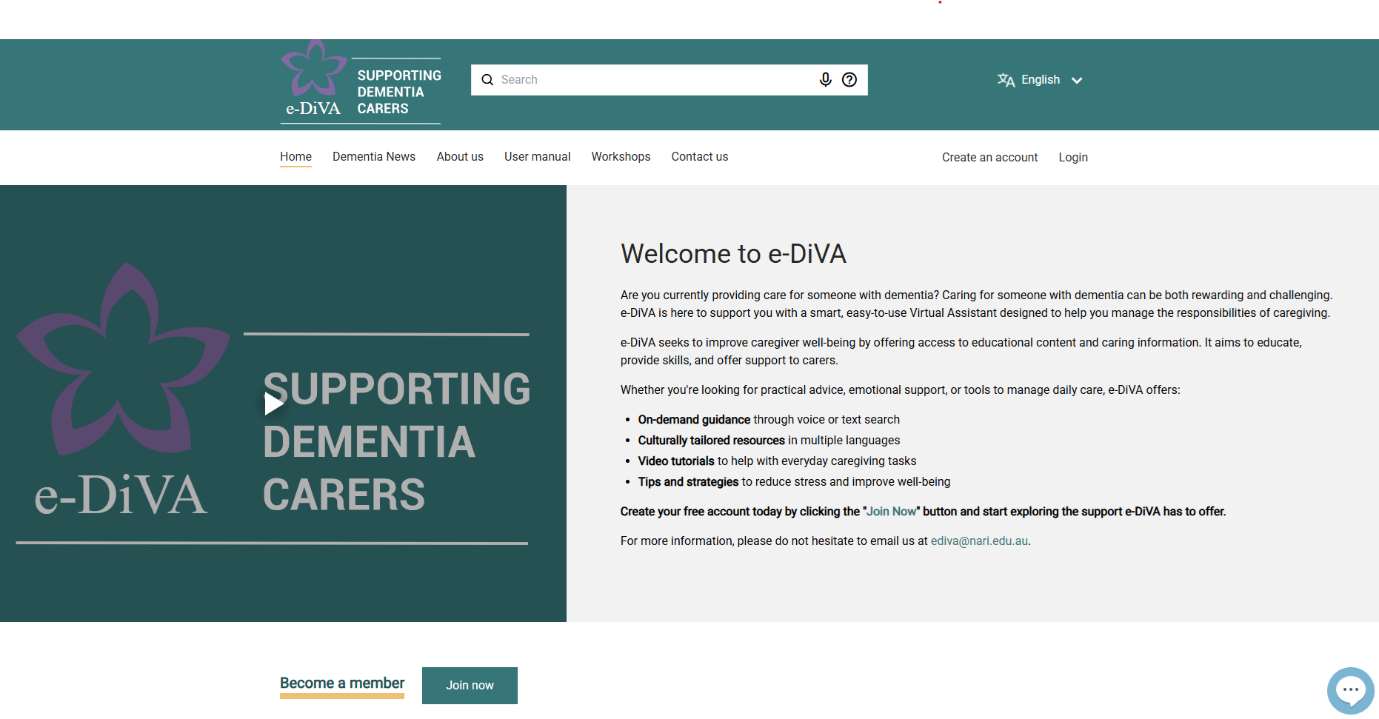
A screenshot of the e-DiVA website welcome page, outlining the content and features.
Testing e-DiVA in real-world settings
e-DiVA has been piloted through a randomised controlled trial across Australia, New Zealand and Indonesia, with a study currently underway in Vietnam. The goal was to understand whether the platform is acceptable, usable and feasible across very different cultural and care systems.
The early results are encouraging. Recruitment targets were met in all participating countries and retention rates were high. Carers consistently reported that the platform felt relevant and easy to use, particularly valuing the culturally specific videos, clear language and practical advice. Many said they would continue using e-DiVA beyond the study period, especially those newer to their caring role.
Importantly, the platform is designed to feel human, not overwhelming. As one participant shared:
I like that it is focused on carers. It is not just a web page full of information – there are different ways of approaching things, so people can gravitate to what works for them.
Another reflected:
It is comforting to have somewhere to go for information, either to confirm what you are already thinking or to open your eyes to something new you could try.
Beyond its immediate benefits, e-DiVA demonstrates something larger: culturally adapted digital dementia support is not only possible – it is welcomed.

Participants trialled e-DiVA for up to 6 months at home via their own devices, and later shared insights on what enabled and encourage them to use the website, barriers they faced, and how best to refine the website going forward. Photo by Centre for Ageing Better on Unsplash.
Looking ahead
The findings from the pilot will guide further refinement of the platform and the design of a larger trial. The long-term goal is to integrate e-DiVA into dementia care systems across the Asia-Pacific, ensuring carers can access meaningful, practical support wherever they live.
Professor Nguyen.:
e-DiVA showed us just how powerful culturally grounded digital support can be, when carers see themselves, their language and their culture reflected, support becomes meaningful.
For millions of families caring behind closed doors, that recognition and that support can make all the difference. e-DiVA is freely available to carers and families. To learn more and access the platform, visit https://ediva.org/
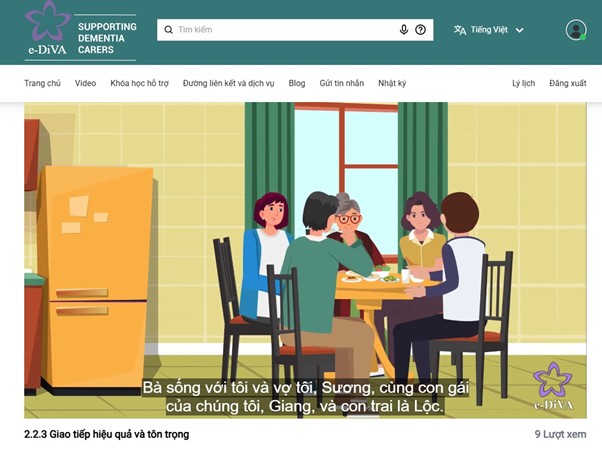
An example of the e-DiVA website interface, displaying a short video on respectful and effective communication to support informal carers of people living with dementia.