
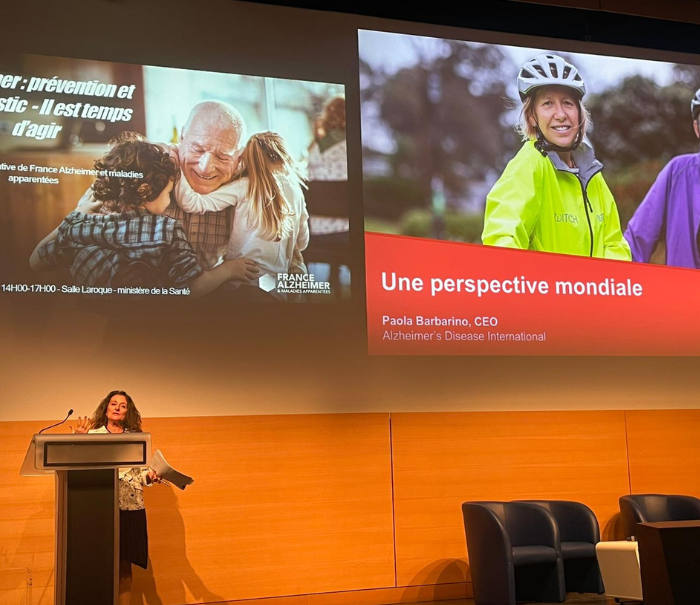
Ahead of ADI’s 2026 Conference in Lyon, ADI CEO Paola Barbarino attended a high-level symposium at the French Ministry of Health, organised by Alzheimer France, to support the advancement of dementia policy within the country. Below is a translated transcript of her speech:
I am very pleased to be with you today for this important symposium, organised by France Alzheimer et Maladies Apparentées. I would like to extend my warm thanks for their invitation to deliver the opening address.
I would like to offer you a global perspective, placing Alzheimer’s disease and related conditions within their current international context. But before getting to the heart of the matter, allow me to introduce Alzheimer’s Disease International (ADI) and explain why I am speaking to you today. Founded in 1984, ADI is the umbrella organisation for more than 100 Alzheimer’s and related disease associations worldwide. We represent our member associations at international bodies such as the WHO, the UN, the OECD, the G7 and the G20, as well as other global and regional organisations. We notably coordinate World Alzheimer’s Month and publish the World Alzheimer Report each year. ADI selects one member per country and France Alzheimer is the representative association of France within our federation. Our vision has always been, and remains, prevention, care and inclusion today, and a cure tomorrow. However, I am also here today to speak to you about what lies ahead—and why the situation is now more urgent than ever.
A brief reminder of the global impact of Alzheimer’s disease and related conditions: every three seconds, someone in the world develops dementia. By 2030, its cost is expected to reach 2.8 trillion dollars, while the number of people affected is estimated at 78 million worldwide. These figures continue to rise, with no sign of slowing.
As part of our work at ADI, we also published a study last year with the London School of Economics (LSE) showing, in essence, that Alzheimer’s disease and related conditions could become the leading cause of death by 2040 in several countries, including France. This may seem striking, but allow me to provide some context.
In 2021, the WHO’s Global Health Observatory ranked Alzheimer’s disease and related conditions as the seventh leading cause of death worldwide. In Europe, it has risen from the tenth leading cause of death in 2000 to the fourth in 2021. In early 2025, in collaboration with the LSE, we published an article in Nature Reviews Neurology. Alzheimer’s disease and related conditions are expected to become the third leading cause of death globally by 2040 and to rank among the top ten causes of mortality in 166 countries. In all G7 countries, it already ranks among the top six causes of death. While these figures may be already alarming, it is essential to understand that they are not declining, they are increasing. In the context of an ageing population, in France as in many other countries, there is an urgent need to act now.
In 2018, the WHO adopted a Global Action Plan on dementia, structured around seven areas presented on this slide. The 194 Member States committed to implementing them and to developing a national plan by 2025. However, many have not succeeded, which has led to the plan being extended by a further six years. Today, our concern particularly relates to France. Although it engaged early in this process, it currently has no dedicated national plan, even though a national strategy on neurodegenerative diseases was launched on 4 September 2025—an initiative we welcome.
Why are these national plans essential? Because they help structure action around key priorities: improving diagnosis and post-diagnostic support, strengthening awareness to combat stigma, and enhancing the training of healthcare professionals. On this last point, needs remain significant, particularly in primary care. According to our 2024 global survey, 64% of healthcare professionals still do not recognise that Alzheimer’s disease and related conditions are not part of normal ageing. There is therefore considerable work to be done in terms of training.
Moreover, national plans are vital for addressing risk reduction—a topic we will discuss at our international conference next week—for better monitoring prevalence and incidence, and for anticipating the arrival of new therapeutic advances, which are now close to becoming a reality.
As of May 2025, France was considered not to have a specific plan. This is also one of the reasons why our Conference will be held in France, in Lyon. Since then, the national strategy for neurodegenerative diseases has indeed been launched, but no concrete measures have yet been implemented and its funding remains unclear.
Our objective is clear: to emphasise how essential it is for France, like other high-income countries, to play a leading role and adopt a dedicated plan. Such a plan is fundamental. Once developed, it is implemented, embedded within a legislative framework and supported by sustainable funding. This funding is crucial for multi-year strategies, as it enables progress in care, supports public policy and strengthens countries’ leadership in tackling Alzheimer’s disease and related conditions. It also provides essential stability for those affected, as well as for their carers and families.
Some countries have already taken several steps by adopting multiple versions of their national plan, such as Chile, Puerto Rico, Chinese Taipei, the Republic of Korea and Japan. More broadly, the number of national plans continues to grow. Since 2021, momentum has clearly accelerated, with a significant increase in the number of countries engaged in this process.
The most recent data notably identify 14 potentially modifiable risk factors. The WHO will soon publish new guidelines, and it is likely that this number will increase. However, the most striking research finding on which we must focus is the following: up to 45% of cases of Alzheimer’s disease and related conditions could be prevented or delayed if risk factors were modified.
If this estimate is applied to France—where the number of cases is expected to exceed 2.1 million by 2050—it would represent approximately 945,000 fewer cases. This is therefore a major lever, which would not only generate significant savings but also substantially reduce stress and burden on families, while preventing many deaths linked to this devastating disease.
The prospect of early diagnosis impacts follow-on care services and support. Effective diagnostic tools are now emerging, including blood-based biomarkers, digital biomarkers, and various cognitive assessments now available on the market. In reality, many governments are not preparing for this. Yet treatments are beginning to emerge—such as donanemab and lecanemab—and other therapies are currently under evaluation.
And where does France stand? Based on the information available to us, none of these treatments are reimbursed. This is a real issue. France does not even reimburse cholinesterase inhibitors, medicines that have been available for more than 15 years.
One might think this situation is acceptable, but it is not. As we have shown in our Travelling for Treatment campaign, it creates profound inequalities. Those who are better off can travel abroad to access these treatments, while those who cannot afford to do so are excluded. This is neither fair nor just. The European Medicines Agency has now approved donanemab in Europe. If France does not reconsider its position, this will mean that only certain patients—those who can afford it—will benefit. Everyone may form their own view, but for us, this is clearly an injustice.
My call to action today is therefore clear: to strengthen international collaboration, which is essential to meet this challenge. It is crucial that France adopts a National Alzheimer’s and related conditions plan. This is the strongest lever to ensure that the healthcare system is prepared to support people living with the condition, as well as their families and carers—particularly in light of advances in diagnosis, prevention and treatment. We must ensure that these advances benefit everyone, not just a minority.